Mines Along The MONON, Page 2
According to the March 1952 Map, produced by the Coal
Trade Association of Indiana, these mines were still being served by the
MONON Railroad.

Midland Mine Company, taken shortly after the turn of the century. This depicts a typical site in the area of that day of a deep coal mine.
Maumee Colliers Mine


Left and Right: The Maumee Colliers was in operation in Greene county south of Linton in the 1940's.
Maumee Collieries Company
also known as Ayrdale. Strip
Mine
Location: North of Cass
Maumee Collieries Company
also known as Linton #28. Strip
Mine

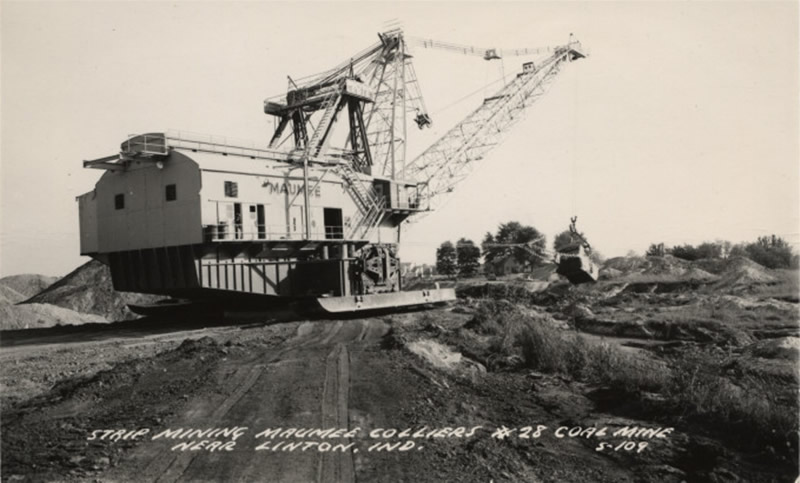
Huge drag line in operation at Maumee Colliers #28. Unknown date.
This strip mine produced 4,121.828 tons of coal from 1949 to 1960. The general location was in Green County south of Jasonville, north of Linton and due east of Vicksburg.


Photos above. Drag line at Maumee
Maumee Collieries Company
also known as Old Glory #33, Cottage Hill.
Strip Mine. Alva Coal Corp.
This strip mine produced 4,592.622 tons of coal from 1959 to 1969. It was located about five miles east of Jasonville off SR48. It is now the location of a landfill.
Sherwood-Templeton Coal Company
Friar
Tuck. Strip Mine And Robin
Hood. Strip Mine

An example of deep coal mining at Sherwood-Templeton.
Robert Maxwell has been working on the MONON operations
in Indiana's mining region for a few years. He put together the information
below.

Friar Tuck Mine Tipple


Drag line at Friar Tuck


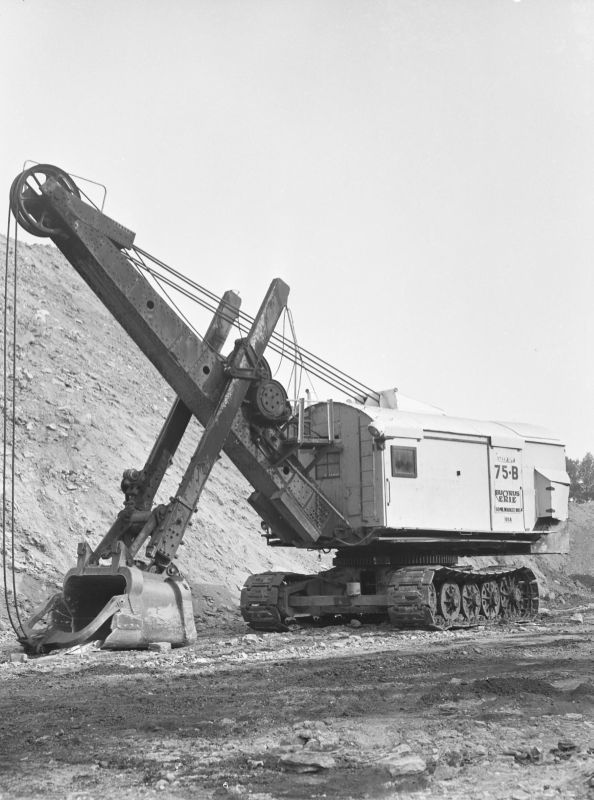
Left: Drag line at Friar Tuck. Shovel at Fria Tuck.
The MONON In The Valley Of The Tipples
The MONON , via the B&B and I&L, served at least 54 coal
mines in the Green/Sullivan and Owen coal fields. Of these mines one of the
most interesting
was the Sherwood Templeton operation about two miles northeast of Dugger, in
the “Valley Of The Tipples”. It was in operation from 1929 to 1960.
This was actually two mines in one location. On one side of the valley was
the Friar Tuck mine tipple. This was a strip mine operated as a partnership
between the Templeton coal company and the Sherwood Company. Templeton had
the land with coal just below the surface, Sherwood the surface-mining capability.
Together they operated an immense strip mine around this location. On the other
side of the valley was the New Hope mine and tipple. Operated by the Templeton
Coal Company, This was a slope mine burrowing into the side of the valley at
an angle.
 Left:
Antioch Power Plant. Date unknown.
Left:
Antioch Power Plant. Date unknown.
* “A little further north in the valley was the Antioch Power
Plant. An impressive facility, fueled by
“Fines.” Fines are
as the name implies, fine coal mostly the consistency of course sand. Fines
were
before
this point in time considered waste, just dumped in piles along with the
overburden. The two mines
produced sufficient fuel to power both mines
and to sell excess
power to surrounding towns.
Today, almost all power in Indiana is produced
by burning fines. Innovations in coal mining which began
at the two mines
include: The first use of permanent processing facilities; first simultaneous
mining
of two
seams; first use of coal reserve areas for farming; first tree planting
on mine spoils; invention of
horizontal drilling for blasting overburden;
first use of fines as fuel, and the development of furnaces made to use
fines; first
company built power plant; and invention of the Baughman coal dryer. All
that remains of the mines today are 25 to 30 ruined buildings, 331 acres
of barren
soil, 138 acres of gob (general overburden), ten acres of slurry, a slurry
pond of 172 acres, 20 acres of acid ponds, water filled mine shafts, several
high wall strip pits, and the network of railroad grades.” As I recall
the power plant was razed in the late 1970s. The area is now is a state run
off road vehicle park.
From 1943 to 1966 the MONON transported coal from Friar Tuck. The
MONON entered the mine from the east on the Cass branch .It left the old
Andromida /Little
Giant trackage near Vicksburg, just south of the wye at M.P. (G-2). However,
from 1933 to 1948 the entire output of New Hope mine was sold to and transported
by the Milwaukee Road, which entered the valley from the north. So one side
of the valley was MONON, the other was Milwaukee, A stones throw from one another.
The MONON got the best deal here. According to a Templeton Coal Company, Inc.
Booklet, “Hope was worth the Risk.” The Friar Tuck tipple processed
the combined output of Friar Tuck and Robin Hood (another huge strip mine in
the same area) with 17,849,935 short tons shipped. New Hope produced 13,255,000
tons for the Milwaukee. Coal from the Robin Hood mine was moved on Milwaukee
trackage to the Friar Tuck tipple.

Strip mining operations at the Robin Hood Mine, 1950
*Excerpts from:
FRIAR TUCK; INNOVATION IN EARLY 20TH CENTURY COAL MINING Brinker, Ruth
(Forest Archaeologist, Wayne Hoosier National Forest)and Quentin Gorton (Purdue
University)
Hope Was Worth The Risk. Templeton Coal Company, Inc.
Green Valley Coal Company
 Green
Valley No.1. Green Valley Coal Company. 127
feet deep. 5.2 foott coal vein.
Green
Valley No.1. Green Valley Coal Company. 127
feet deep. 5.2 foott coal vein.
Mined 3,331.000 tons Operated
1902-1924.
The location was on the east side of SR48 directly
across from the
Shakamak State Park entrance.
| Mines
1 | Mines 2 |
Return To Index